
GCC Support Modernization: AI-Driven Solutions for Global Capability Centers
Executive Summary
Global Capability Centers (GCCs) have evolved from cost-saving back offices into strategic technology and innovation powerhouses. However, many organizations still grapple with fragmented support structures, reduced agility, and persistent talent bottlenecks. This comprehensive analysis explores the changing landscape of GCC support modernization, identifies critical pain points, and demonstrates how Alpha Net Consulting’s AI-driven solutions for global capability centers can modernize, scale, and automate operations through artificial intelligence, agentic support frameworks, and federated delivery models backed by robust technical infrastructure.
Introduction: GCCs at a Crossroads
The Global Capability Center landscape has experienced unprecedented growth and transformation over the past two decades. India alone hosts over 1,600 GCCs, contributing more than $50 billion in annual value. The domestic GCC market is projected to reach $110 billion by 2030, with India potentially housing around 2,400 GCCs by that time. This explosive growth represents more than just numerical expansion—it signals a fundamental shift in how multinational corporations approach global capability center automation and talent utilization across key locations like Bangalore, Manila, and Romania.
The evolution of GCCs can be traced through distinct phases: the initial cost arbitrage phase (2000-2010), the efficiency optimization phase (2010-2018), and the current innovation acceleration phase (2018-present). Today’s GCC operations operate in an entirely different paradigm, where they’re expected to drive digital transformation, spearhead AI initiatives, and serve as innovation laboratories for their parent organizations.
However, this rapid evolution has created a critical disconnect that threatens to undermine GCC effectiveness. While GCCs are now expected to lead AI initiatives and product innovations, their underlying support structures—including Level 1/Level 2 operations, service desks, and infrastructure management—haven’t kept pace with these elevated expectations. Support infrastructure is becoming the bottleneck rather than the enabler of GCC success.
Traditional GCC Support: The Fractured Reality
Disjointed Operations Create Systemic Inefficiencies
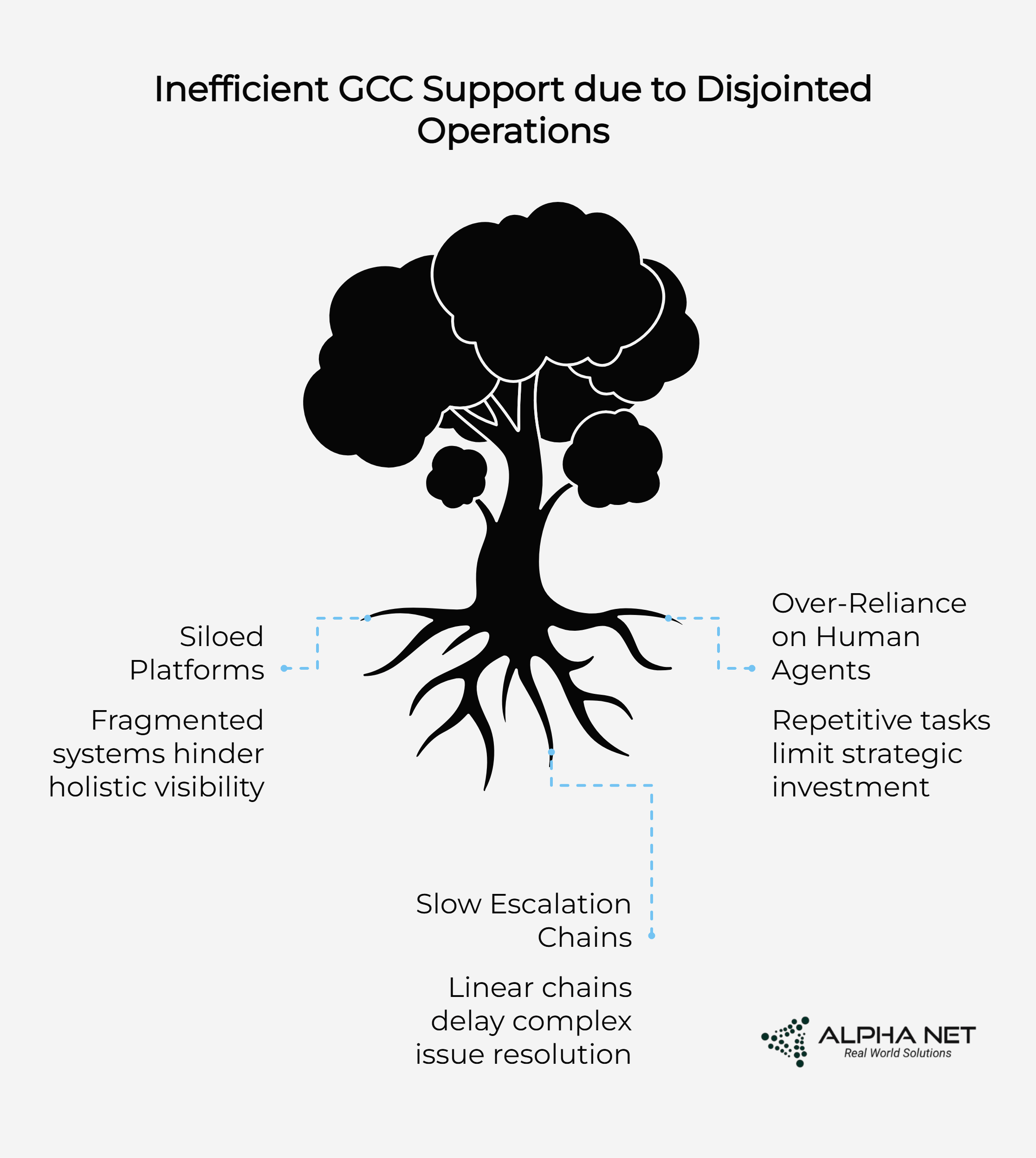
Most GCCs operate with fragmented support ecosystems where ticketing systems, knowledge bases, and Service Level Agreement (SLA) management run on completely siloed platforms. This fragmentation creates multiple points of failure and prevents organizations from achieving holistic operational visibility. Consider a typical enterprise GCC managing support for multiple business units: the infrastructure team uses one ticketing system, the application support team uses another, and the security team maintains its own incident management system. When issues span multiple domains, coordination becomes a manual, time-intensive process that delays resolution and frustrates end users.
Overstaffing Without Strategic Value
Traditional GCC support models rely heavily on human agents tied to repetitive, low-value tasks. High attrition rates plague Level 1 support roles, creating constant training overhead and knowledge loss. Organizations typically spend 60-70% of their support budget on Level 1 activities that add minimal strategic value, preventing GCCs from investing in higher-value capabilities like predictive analytics and strategic technology initiatives.
Slow Escalation Chains Delay Resolution
Linear support chains create unnecessary delays in incident handling, particularly for complex issues requiring expertise from multiple domains. When Level 1 support in one region needs to escalate to Level 2 expertise in another region, the handoff process often introduces additional delays. Critical business issues can remain unresolved for hours while they navigate through multiple escalation tiers and regional handoffs.
Alpha Net Consulting’s Comprehensive Technical Infrastructure Approach
The Missing Technical Layer
With over 25 years of experience tackling complex business problems through technology, Alpha Net Consulting understands that successful GCC modernization requires both strategic transformation and robust technical infrastructure. You can have the most sophisticated AI agents in the world, but if your backend plumbing is broken, you’re just automating chaos.
Event-Driven Architecture for Global Operations
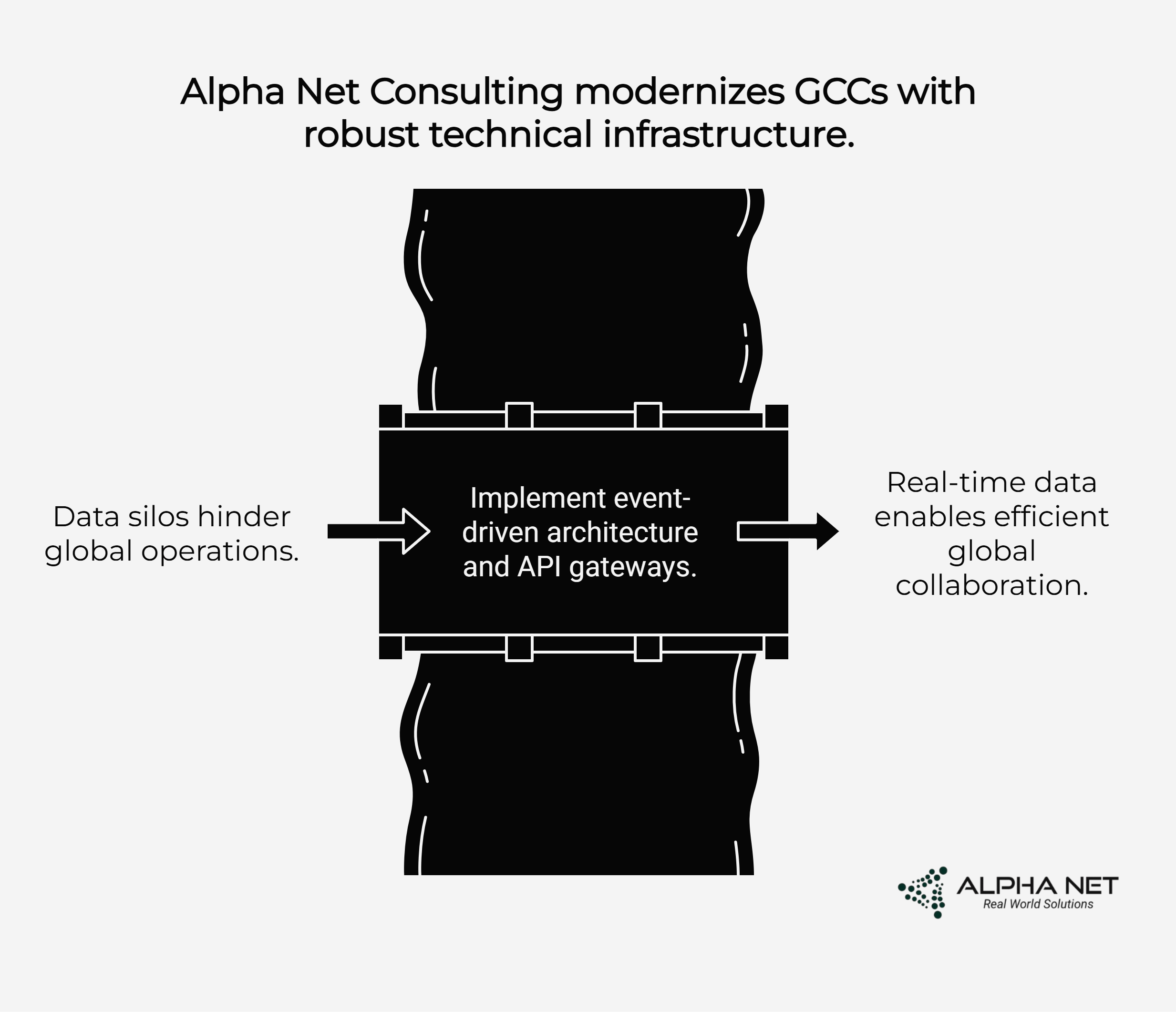
Alpha Net Consulting’s technical teams specialize in building event-driven architectures that handle real-time data synchronization across multiple regions. When an incident happens in your New York office, teams in Bangalore, Manila, and Romania see the same information simultaneously through sophisticated message queuing systems using Apache Kafka and AWS Kinesis.
Technical Implementation: Alpha Net Consulting implements distributed state management across time zones, fault-tolerant message buses with circuit breakers, and conflict resolution algorithms that ensure data consistency while maintaining audit trails for compliance purposes.
Integration Layer Excellence
Modern GCCs orchestrate dozens of systems: ServiceNow, Jira, Freshdesk, Azure DevOps, AWS CloudWatch, and Splunk. Alpha Net Consulting builds robust API gateways that handle authentication and authorization across multiple systems, rate limiting to prevent system overload, intelligent routing across backend services, and comprehensive security monitoring.
Data Transformation Capabilities: Customer information might be structured differently across systems. Alpha Net Consulting’s integration platform includes sophisticated mapping and transformation logic that handles edge cases and data quality issues automatically, while managing API versioning and compatibility across different system versions.
The Shift: From Reactive Support to Federated Intelligence
Implementing Federated Models for Global Efficiency
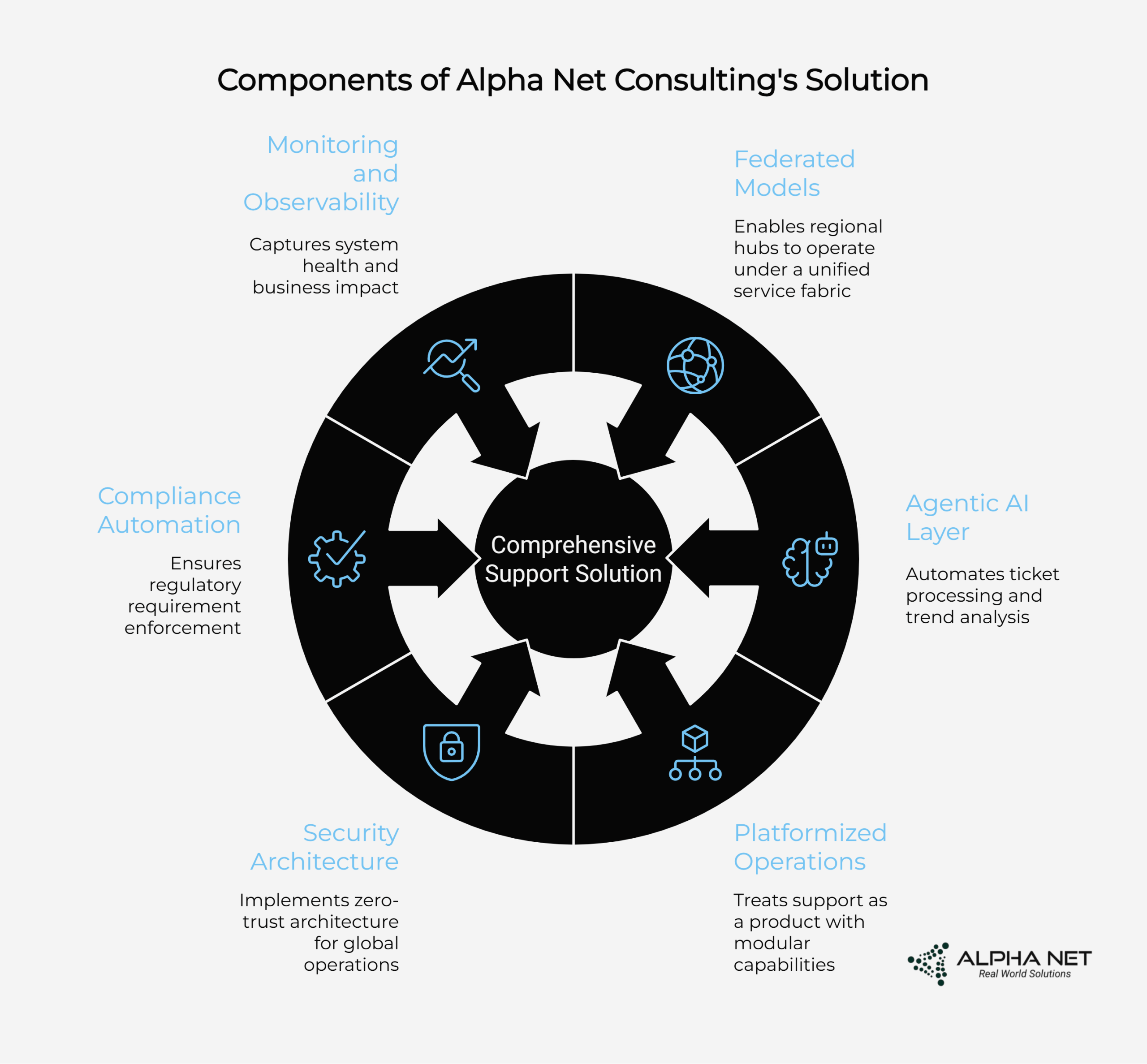
Alpha Net Consulting’s federated models enable regional hubs to operate under a unified service fabric while maintaining their unique strengths. This approach leverages global talent pools and technological advancements to drive business transformation. In a truly federated model, support capabilities are abstracted from physical locations, allowing organizations to route work to the most appropriate resources regardless of geography.
Agentic AI Layer: Intelligent Automation at Scale
Alpha Net Consulting’s advanced GCC support structures incorporate intelligent agents that automatically process tickets, analyze operational trends, and surface root causes before they impact business operations. These agentic AI systems go beyond traditional chatbots, incorporating natural language processing, machine learning, and contextual reasoning capabilities.
Technical Architecture: The AI infrastructure includes clean data pipelines extracting from multiple source systems, model training infrastructure with significant computational resources, real-time inference engines for automated decision-making, and continuous learning systems that improve over time.
Platformized Operations: Support as a Product
Alpha Net Consulting treats modern GCC support as a product rather than a process, with dedicated product management, user experience design, and continuous improvement methodologies. The platform approach enables modular capabilities that can be composed and recomposed based on changing business needs, creating reusable components that can be rapidly deployed, scaled, or modified.
Technical Architecture Deep Dive
Security Architecture for Global Operations
Alpha Net Consulting implements zero-trust architecture where every request is authenticated and authorized, AI agents operate within strict security boundaries, and secure data sharing occurs across regions. The security framework addresses unique challenges of AI-powered support systems, including protection against adversarial attacks on AI models and ensuring integrity of training data.
Compliance Automation Framework
Alpha Net Consulting’s systems provide automatic audit trail generation, data lineage maintenance, regulatory requirement enforcement, and multi-jurisdictional compliance management. The compliance capabilities address unique challenges of global operations where different regions may have conflicting regulatory requirements.
Monitoring and Observability Evolution
Alpha Net Consulting’s shift from traditional SLA-driven metrics to outcome-based KPIs requires comprehensive instrumentation that captures not just system health but also business impact. This includes distributed tracing that follows support requests through initial submission, automated processing, AI escalation, human intervention, and final resolution.
Alpha Net Consulting’s Comprehensive Solution Matrix
Business Need | Alpha Net Consulting Solution |
Eliminate ticket backlogs | Agentic L1 bots with automated triage and self-healing automation |
Reduce cost per ticket | Federated shared services across all GCC locations |
Improve governance | Smart dashboards with RCA engines and escalation predictors |
Empower support teams | GenAI copilots with AI-powered knowledge bases |
Speed up onboarding | AI-assisted agents embedded in ServiceNow, Jira, Freshdesk |
Enable 24×7 resilience | Global follow-the-sun model with intelligent automated handoffs |
Implementation Success Stories
APAC FinTech: Dramatic Volume Reduction
A leading APAC financial technology company achieved a 60% reduction in Level 1 ticket volume using Alpha Net Consulting’s auto-resolution bots. The solution included intelligent routing that automatically categorized tickets based on business impact, automated resolution of routine requests, and predictive analytics that identified potential issues before they generated support tickets.
US Pharma GCC in Pune: Unified Operations
A major pharmaceutical company’s Pune-based GCC unified support across infrastructure and application teams using Alpha Net Consulting’s federated AI command center. The unified approach enabled end-to-end service management with automated escalation management, comprehensive audit trails for regulatory compliance, and integrated knowledge management across all technical domains.
Global SaaS Product GCC: Knowledge Transformation
A global Software-as-a-Service provider transformed their knowledge base using Alpha Net Consulting’s GenAI and search feedback loops. The AI-powered knowledge system generated customized troubleshooting guides, automatically updated documentation based on successful resolution patterns, and provided interactive guidance that adapted to user skill levels.
Getting Started: Alpha Net Consulting’s GCC Support Modernization Playbook
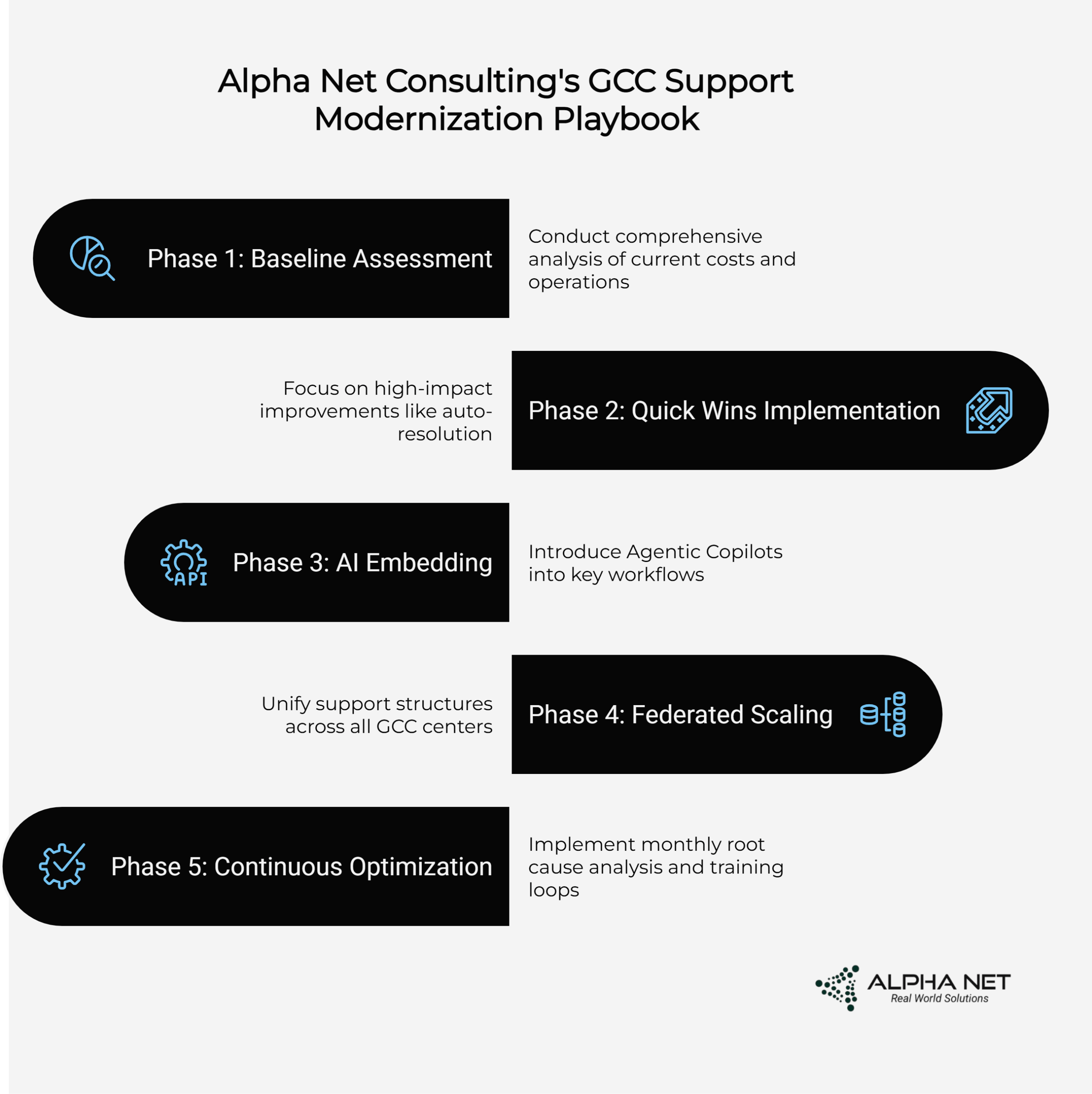
Phase 1: Baseline Assessment (2-4 weeks)
Alpha Net Consulting conducts comprehensive analysis of current costs, ticket volumes, resolution times, and operational gaps, including detailed process mapping, technology inventory, and skill assessment.
Phase 2: Quick Wins Implementation (4-8 weeks)
Focus on high-impact improvements including auto-resolution capabilities, unified operational dashboards, and knowledge base modernization that provides immediate value while building organizational confidence.
Phase 3: AI Embedding (8-12 weeks)
Introduce Agentic Copilots into key workflows, enabling human agents to handle complex issues while automation manages routine tasks. Implementation includes comprehensive training programs for existing staff.
Phase 4: Federated Scaling (12-16 weeks)
Unify support structures across all GCC centers, creating seamless handoffs and leveraging regional expertise while maintaining local customization based on regulatory constraints and cultural factors.
Phase 5: Continuous Optimization (Ongoing)
Implement monthly root cause analysis and agent training loops ensuring continuous improvement, including regular performance reviews, user feedback collection, and technology updates.
Industry Trends and Future-Proofing
Exponential Growth Projections
Global companies are increasingly setting up GCCs in India, Philippines, and Romania to tap into cost-effective talent and drive innovation. This growth is driven by recognition that GCCs provide access to specialized skills, enable rapid scaling, and serve as innovation laboratories for new technologies.
Emerging Technology Integration
Alpha Net Consulting designs next-generation GCC support infrastructure to accommodate quantum computing capabilities, advanced machine learning models, blockchain-based security frameworks, and IoT device management capabilities. Organizations that plan for these technologies today will be better positioned to leverage them as they mature.
Sustainability and Compliance Evolution
Modern GCC support structures must consider environmental impact and evolving regulatory requirements. Alpha Net Consulting integrates sustainability considerations through energy-efficient operations and implements automated compliance capabilities that can adapt to changing requirements across different jurisdictions.
Conclusion: Scale Intelligence, Not Legacy
As GCCs expand in both size and strategic importance, organizations face a fundamental choice: scale legacy support models that create bottlenecks, or invest in Alpha Net Consulting’s intelligent, federated systems that enable true operational excellence and strategic value creation.
Alpha Net Consulting helps global firms rethink their support backbone so it’s not just bigger—it’s faster, more intelligent, and ready for the AI age. The question isn’t whether your GCC will grow; it’s whether your support structures will enable or constrain that growth and strategic potential.
The future belongs to organizations that recognize support infrastructure as a strategic differentiator and competitive advantage. By implementing Alpha Net Consulting’s AI-driven solutions for global capability centers through federated support models, GCCs can finally realize their full potential as drivers of innovation and competitive advantage.